- Home
- Posts
- Ko-fi vs. Patreon vs. beehiiv: Monetization Compared
Ko-fi vs. Patreon vs. beehiiv: Monetization Compared
A Side-by-Side Comparison of Fees, Features, and Monetization Models

Nicola Vaughan
March 08, 2026

Monetizing a business can be tricky, especially when there are so many platforms to choose from.
There’s a common debate between Ko-fi and Patreon as the best monetization platform for creators, with both platforms being seen as solutions for donations, memberships, and community support.
But as creators shift towards monetizing newsletters vs community support, beehiiv has entered the conversation.
This guide will compare Ko-fi vs. Patreon vs. beehiiv to help you understand how their fees, features, and monetization tools differ.
We’ll help you decide the best platform for paid subscribers for your business, based on your individual business goals.
Table of Contents
Ko-fi vs. Patreon vs. beehiiv: Which Is Best for Creators?
When comparing Ko-fi vs. Patreon vs. beehiiv, it’s important to understand that these platforms are built with different types of creators in mind.
While Ko-fi and Patreon focus on community support and fan-funded income, beehiiv is centered more towards building an owned audience and monetizing through paid subscriptions.
If you’re choosing between monetizing newsletters vs. community support, the “best” platform depends on how you plan to monetize, your thoughts around owning your audience, and whether you’re building for short or long-term revenue.
Below is a clear breakdown of how each platform serves creators and where their strengths lie.
Overview of Ko-fi’s Monetization Features
Ko-fi tends to be positioned as a lightweight alternative to Patreon. It allows creators to accept one-time donations (such as “buy me a coffee”), sell digital products, and offer optional monthly memberships.
This platform stands out when it comes to flexibility and simplicity.
Creators use Ko-fi for the following tasks:
Accept one-time tips
Sell commissions, downloads, or small products
Offer memberships without a complex tiering structure
Use with a “pay what you want” model
One of Ko-fi’s biggest advantages is that there are no platform fees for its free plan. This makes it an attractive option for new creators who are testing the waters and aren’t keen to commit to a subscription yet.
However, Ko-fi does have some limitations, with a lack of built-in tools for audience growth, advanced analytics, and structured content delivery.
There’s also no native email list ownership system, making it difficult to turn supporters into long-term paid subscribers. And while the free plan is great, payment processing fees still apply.
If your goal is scalable recurring income, Ko-fi works best as a supplement, rather than a core business platform.
What Patreon Offers for Creators
Patreon is one of the most established and well-known membership platforms available. It’s built around tiered subscriptions, allowing fans to pay monthly for exclusive content, early access, or extra perks.
Here are some of its notable features:
Robust membership tiers
Native fan discovery within the platform
Private posts, communities, and gated content
Reliable recurring income structure
This platform suits creators who are focused on community-driven monetization, particularly podcasters, YouTubers, and artists with loyal followings.
That said, many creators eventually become concerned with the steep fees Patreon takes. Its costs range from 8% - 12%, plus payment processing fees, which can really start to add up as your income grows.
Patreon can also become difficult to manage at scale. Tier complexity, content obligations, and limited audience ownership can make it difficult to pivot or migrate. This is why many creators start searching “what is better than Patreon” once their business matures.
How beehiiv Supports Paid Subscribers and Monetization
beehiiv approaches monetization from a very different angle. Instead of focusing on tips or community posts, beehiiv is built for creators who want to grow an owned email audience and monetize through paid newsletter subscriptions.
beehiiv enables creators to do the following:
Launch free and paid newsletters in minutes
Convert readers into paid subscribers seamlessly
Own their email list and subscriber data
Generate recurring revenue
Grow organically through a built-in referral program and SEO
Unlike Ki-fo or Patreon, beehiiv is made for creators who want to build long-term growth, rather than just collecting tips or donations. There are no complicated tiers to manage, just clear value delivered through premium content.
Creators who are focused on choosing the best platform for paid subscribers often opt for beehiiv because it removes friction, reduces reliance on algorithms, and gives them more control over distribution and monetization.
5 Key Features of Ko-fi, Patreon, and beehiiv Compared
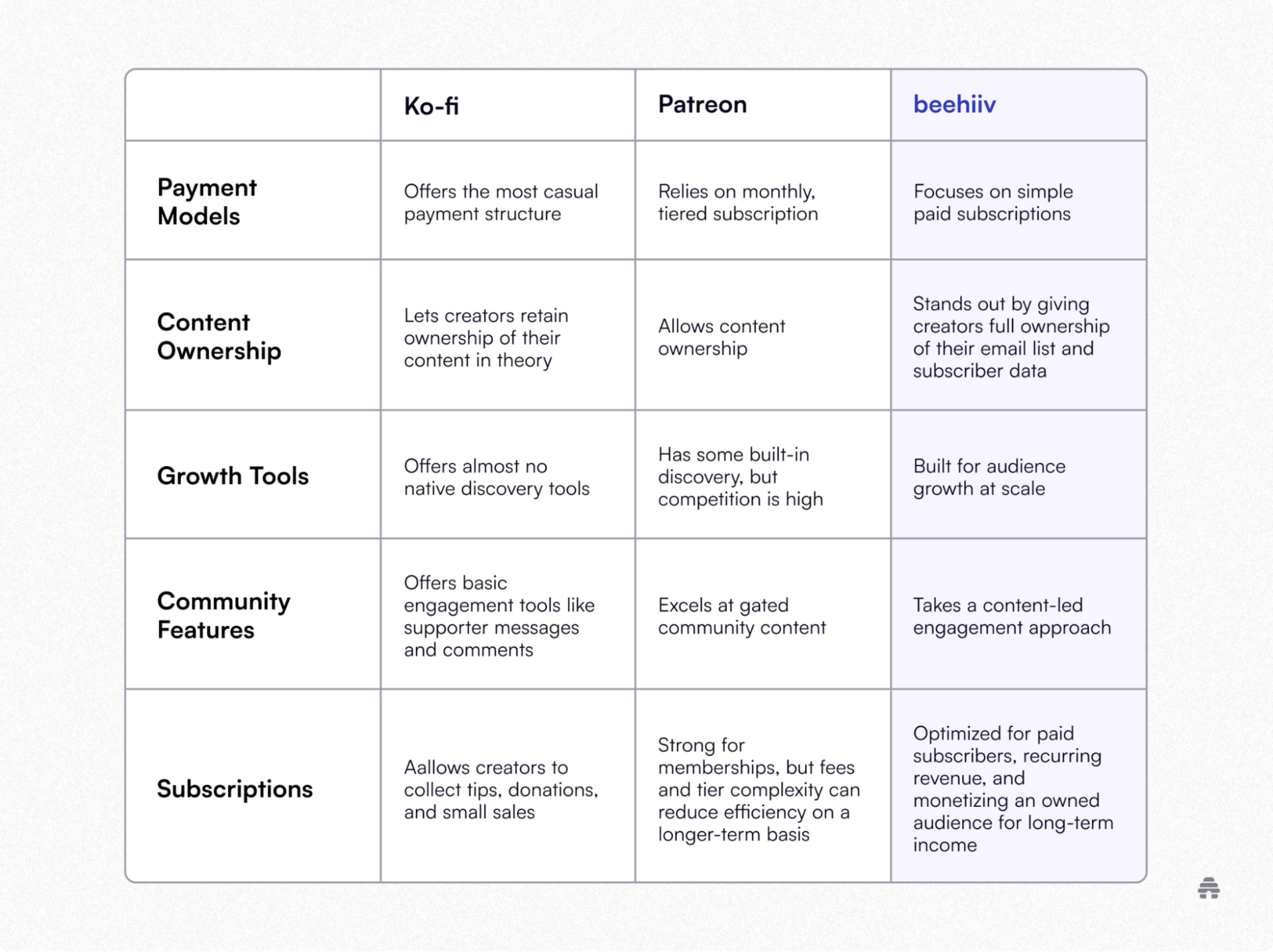
When deciding between Ko-fi vs. Patreon vs. beehiiv, creators need to also focus on how each platform supports long-term income, audience ownership, and growth.
Below, we’ve compared the five most important features creators should evaluate when choosing the best platform for paid subscribers or community-backed monetization.
Flexible Payment Models for Creators
Payment flexibility is often the first deciding factor when comparing Patreon vs. Ko-fi, and it’s also where beehiiv takes a fundamentally different approach.
Ko-fi offers the most casual payment structure. Monetization is achieved through one-time donations, recurring contributions, or purchases without commitment. This flexibility is great for creators who don’t want to lock fans into subscriptions, but it does result in unpredictable income.
Patreon relies on monthly, tiered subscriptions. While this is good for recurring revenue, it often forces creators to maintain multiple reward levels, which can be complex and require extra admin.
beehiiv focuses on simple paid subscriptions. Readers can choose between subscribing for free or paying for premium access, without the confusion of different tiers. This also makes monetization cleaner and more scalable for the creator.
Community Engagement and Fan Interaction Tools
Community engagement plays a big role in creator monetization, but how that interaction happens differs across these platforms.
Ko-fi offers basic engagement tools like supporter messages and comments, but it lacks structured community features.
Patreon excels at gated community content. Creators can publish exclusive posts, host member discussions, and reward loyal fans. However, engagement often stays inside Patreon, limiting how creators can repurpose their audience elsewhere.
beehiiv takes a content-led engagement approach. Creators build trust through consistent newsletter delivery, with paid subscribers receiving exclusive insights directly into their inbox.
Content Ownership and Platform Policies
Content ownership is critical when choosing a monetization platform to give you flexibility when moving platforms or repurposing your audience.
Ko-fi lets creators retain ownership of their content in theory, but offers little protection or portability if you migrate to a different platform.
Patreon allows content ownership, but, in fact, the platform owns the relationship with your audience. This means that if policies change or accounts are restricted, creators would have limited control over migration.
beehiiv stands out by giving creators full ownership of their email list and subscriber data. This means you can export, migrate, or monetize your audience independently, making beehiiv the most future-proof of the three platforms.
Audience Growth and Marketing Tools
Growth is where Ko-fi and Patreon start falling behind.
Ko-fi offers almost no native discovery tools. Growth is dependent entirely on external platforms like X (Formerly Twitter), Instagram, or YouTube.
Patreon has some built-in discovery, but competition is high, and creators still rely heavily on external marketing channels for traffic.
beehiiv is built for audience growth at scale, offering native referral programs, SEO-optimized newsletter pages, recommendation networks, and 3D Analytics designed for subscriber growth. This makes beehiiv especially powerful for creators focused on monetizing their newsletter, with growth that compounds over time.
Monetization and Subscription Models
Finally, let’s compare how each platform helps creators actually make money.
Ko-fi allows creators to collect tips, donations, and small sales, but income is inconsistent and unpredictable due to their “no commitment required” model.
Patreon is strong for memberships, but fees and tier complexity can reduce efficiency on a longer-term basis.
beehiiv is optimized for paid subscribers, recurring revenue, and monetizing an owned audience for long-term income.
Creators asking “what is better than Ko-fi?” or “what is better than Pateron?” often arrive at beehiiv once they prioritize ownership, scalability, and simplicity.
Why Listen to Me? I have been working in the digital marketing space for nearly 10 years, predominantly helping brands with their email marketing and online presence. I now specialize in creating great content for beehiiv to help people nail their email strategies!
beehiiv’s Unique Advantage: Paid Newsletters for Long-Term Success

While Ko-fi and Patreon are often mentioned in conversations around creator monetization, both platforms were designed for community support, not audience ownership.
beehiiv is very different here. Instead of relying on one-off tips or gated communities, beehiiv empowers creators to build direct relationships with their audience. They teach how to monetize these relationships via paid subscriptions and build a real, owned audience.
Creators deciding between monetizing newsletters vs. community support often look to beehiiv because it offers a model that prioritizes sustainability, control, and growth.
How beehiiv Helps You Build an Audience and Earn Recurring Revenue
beehiiv is designed around a simple but powerful idea: your email list is your business.
All subscribers are owned by you, not an algorithm, platform, or marketplace that can change the rules at any time.
Unlike Ko-fi and Patreon, which depend heavily on external traffic sources and platform loyalty, beehiiv helps with the following actions:
Captures emails directly from readers
Nurtures trust through consistent content
Converts free readers into paid subscribers
Earns predictable monthly/annual revenue
This model is particularly effective for writers, analysts, educators, and niche creators who want to monetize expertise rather than fun perks.
Paid newsletters also scale more efficiently than tiered memberships, with one piece of premium content serving thousands of subscribers with little added complexity.
For creators asking “what is better than Patreon for recurring income?”, beehiiv’s subscription-first approach is often the answer.
A great success story of the beehiiv platform is Jennifer Chou, who made $16,000 on beehiiv in less than four months -- check out the full case study here.
beehiiv’s Subscription Features: Easy Setup for Paid Newsletters
One of beehiiv’s biggest strengths is how easy it is to launch and manage paid subscriptions.
Creators can set up free and paid tiers offering monthly or yearly pricing options. They can lock premium content easily, upgrade free readers to paid subscribers on request, and analyze conversion rates to see where they’re achieving the best results.
You don’t need to design complex reward structures or manage multiple membership tiers like on Patreon. beehiiv keeps the focus on content quality and consistency, which is what drives long-term revenue.
beehiiv’s simplicity is particularly appealing to creators who want the best platform for paid subscribers, but without spending hours managing backend logistics.
Why beehiiv Is the Best Option for Growing a Newsletter-Based Business
When comparing Patreon vs. Ko-fi vs. beehiiv, the long-term advantage becomes clear when growth comes into the picture.
beehiiv is purpose-built for scaling, with the following features:
Native referral programs turning readers into promoters
SEO-friendly landing pages attracting organic traffic
Recommendation networks exposing newsletters to new audiences
Analytics revealing what content converts best
Most importantly, creators maintain full control over their audience and revenue streams. If you ever choose to leave beehiiv or use your audience elsewhere, your email list goes with you, something that Patreon and Ko-fi don’t allow.
For creators serious about turning content into a business, beehiiv isn’t just another monetization tool. It exists as a powerful infrastructure that stands out as the strongest alternative for anyone asking, “What’s better than Ko-fi or Patreon?”.
Ko-fi vs Patreon vs beehiiv: Which Platform Should You Choose?
After comparing all of the features, fees, audience ownership, and monetization models, the choice between Ko-fi vs. Patreon vs. beehiiv comes down to what sort of creator business you want to build.
Each platform serves a different purpose, and understanding these differences is the key to making the right call.
Choose Ko-fi for No-Commitment and One-Time Payments
Ko-fi is best suited for creators who want one-time donations/tips, simple monetization without commitment, and a lightweight alternative to subscription models.
Ko-fi works best for hobbyists, artists, and streamers who already have an audience and don’t want to lock supporters into monthly payments. However, it’s not ideal if your goal is scalable income or long-term growth.
Choose Patreon for Community Membership
Patreon makes sense if your content revolves around exclusive community access, tiered memberships with ongoing rewards, and fan-driven engagement and perks.
Patreon is effective for podcasters, YouTubers, and creators with highly engaged fanbases. However, with increasing fees, tier management, and limited audience ownership, creators often leave it in search of an alternative.
Choose beehiiv To Build a Focused, Paid Newsletter Subscription Business

beehiiv is the clear winner for creators focused on monetizing newsletters vs. community support, owning their audience and subscriber data, long-term business growth, and building a predictable, recurring revenue source.
beehiiv removes unnecessary complexity and replaces it with a clean, scalable subscription model. Instead of chasing algorithms or managing membership tiers, creators can focus on delivering value straight to their audience’s inbox.
For writers, educators, analysts, and niche experts, beehiiv consistently proves to be the best platform for paid subscribers and the strongest alternative to Ko-fi or Patreon.
If your goal is to build a sustainable, scalable income stream around content you own, start a 14-day free trial with beehiiv today. It’s not just a monetization platform; it’s a foundation for turning your audience into a real business.
Google’s People Also Ask Questions:
What is better, Patreon or Ko-fi?
When comparing Patreon vs. Ko-fi, the better platform depends on how you want to earn money as a creator.
Ko-fi is better for creators who prefer one-time donations, tips, and low-commitment support with minimal setup. Patreon is better for those looking to create a recurring income stream through memberships and tiered subscriptions.
However, both platforms focus heavily on community support, rather than audience ownership. Creators who are looking for predictable revenue and full audience control often outgrow these platforms and look for alternatives like beehiiv.
What are the disadvantages of Ko-fi?
While Ko-fi is easy to use, it has several disadvantages in terms of long-term growth, including:
Inconsistent income due to focus on one-time donations
Limited tools for audience growth
No built-in email list ownership
Basic analytics compared to other platforms
Not designed for scaling paid subscribers
Ko-fi works best as a supplemental income tool, but it isn’t ideal for creators focused on building a sustainable, subscription-based business.
Is Ko-fi better than Patreon Reddit?
Discussions on Reddit around “Is Ko-fi better than Patreon?” tend to reflect creator frustration with Patreon’s fees and tier complexity. Many Reddit users prefer to use Ko-fi because it offers lower fees, a simple setup, and fewer commitments.
However, Reddict creators often point out that Ko-fi lacks structure for recurring income. As a result, many creators use Ko-fi alongside Patreon or transition to platforms that support both owned audiences and paid subscriptions more effectively.
What is better than Ko-fi?
For creators seeking an alternative to Ko-fi, the answer depends on their goals:
Patreon is better if you’re looking for structured monthly memberships
beehiiv is better if you want to build paid subscribers and recurring newsletter revenue.
Unlike Ko-fi, beehiiv allows creators to fully own their audience, grow organically through SEO and referrals, and monetize content with a simple subscription model.
Related Articles


The one place to build.